Chimney Breast Removal Cost: 2026 UK Prices and Rules
The typical chimney breast removal cost in the UK is £1,500–£3,500 for one breast on one floor, and about £3,000–£6,000 or more to take out the whole chimney from ground floor to roof. The price depends on how much you remove, how the brickwork left above is held up, and how much making good is needed afterwards. This guide compares four price guides, shows what three councils charge for building control in 2026, explains the gallows bracket rules, and works through three real-world budgets.
Quick answer
- Ground floor breast only: £1,500–£1,750 (MyJobQuote, Nov 2026); Checkatrade gives £1,750–£3,250 plus VAT for a breast with the stack left in place.
- First floor breast: £1,750–£2,000 (MyJobQuote).
- Chimney stack only: £1,200–£1,400 (MyJobQuote), or about £300 per metre (Checkatrade).
- Whole breast and stack: £3,000–£3,500 for the work itself (MyJobQuote), before scaffolding, making good and fees.
- Building control fee: £338 (Burnley) to £457 (Enfield) in 2026, including VAT. You’ll almost always need approval.
- On a party wall? You need to serve a party wall notice at least two months before work starts.
Last checked: 16 November 2026. England rules; Wales and Scotland differ.
How much does chimney breast removal cost in 2026?
Price guides don’t agree on the exact number, because they price slightly different jobs. Some quote the removal alone. Others include making good, waste or a share of the building control fee. Here’s how four guides compare:
| Job | MyJobQuote (Nov 2026) | Checkatrade (Apr 2026) | Homebuilding & Renovating (Oct 2022) | Hamuch (Mar 2026) |
|---|---|---|---|---|
| Ground floor breast | £1,500–£1,750 | £1,750–£3,250 + VAT (stack stays) | £1,500–£3,500 | £450 average labour per day |
| First floor breast | £1,750–£2,000 | As above | £1,500–£3,500 | – |
| Breast over two floors (stack stays) | £2,200–£2,400 | – | – | £700 average labour per day |
| Non-load-bearing (false) breast | £900–£1,300 | £400–£600 + VAT | From about £500 | – |
| Stack only | £1,200–£1,400 | About £300/m, or about £1,800 a project | About £300/m | £340 average labour per day |
| Whole breast and stack | £3,000–£3,500 | – | £5,000–£6,000 budget (Victorian house) | £900 average labour per day |
| Making good | £750–£1,250 | £150–£210 per breast | Plastering from about £135/day | – |
Hamuch figures are average labour costs per day, excluding VAT and materials, not job totals. Homebuilding & Renovating’s figures are from 2022 and are likely to be low for 2026. Checkatrade’s prices exclude VAT; MyJobQuote’s are typical totals.
Read across the table and a clear pattern shows. Taking out a single breast on one floor is a £1,500–£2,000 job in most of England. Removing the full chimney, from fireplace to pot, costs about twice that before scaffolding and making good. Outer London and the South East usually sit at the top of each range. MyJobQuote says London day rates run £30–£70 more per person.
Labour and day rates
Most of the cost is labour. MyJobQuote puts a builder at £200–£300 a day per person, and Checkatrade at £220–£300. A two-person team usually takes 1.5–2 days for a ground floor breast and 3–4 days for a full breast and stack. MyJobQuote’s labour-only figures for a team of two are £600–£1,200 for a ground floor breast and £1,200–£2,400 for the whole chimney.
Extras that are often left out of quotes
| Item | Typical cost | Source |
|---|---|---|
| Structural engineer’s calculations | £250–£600 | MyJobQuote; Homebuilding & Renovating says £350–£500 for a simple job |
| Scaffolding (stack removal) | £300–£400 (MyJobQuote); about £660 a week (Checkatrade) | Two guides |
| Skip | £100–£200 (MyJobQuote); £75–£450 a week (Checkatrade) | Two guides |
| Replastering a wall | £250–£400 | MyJobQuote |
| Reboarding a ceiling | £250–£600 | MyJobQuote |
| Levelling the floor where the hearth was | £200–£500 | MyJobQuote |
| Replacing up to five roof tiles | About £170 | Checkatrade |
| Gas fire disconnection (Gas Safe engineer) | £50–£100 | Homebuilding & Renovating (2022) |
| Asbestos removal, if found | About £175 per m² | Checkatrade |
Ask each builder to list these separately. A low quote that leaves out making good, the skip and the engineer can end up costing more than a higher, all-in one.
What affects the cost?
How much of the chimney you remove
A chimney is one tall stack of brickwork. The breast on the ground floor carries the breast on the first floor, which carries the stack through the roof. Take out the bottom section and everything above it needs new support. That’s why removing only the ground floor breast still involves structural work, and why removing the whole chimney can be simpler from a structural point of view: there’s nothing left to hold up.
How the remaining brickwork is supported
There are two main ways to support what’s left:
- Gallows brackets: steel angle brackets bolted into the wall under the remaining breast. They’re cheap and quick, but many councils now restrict them (see the rules below).
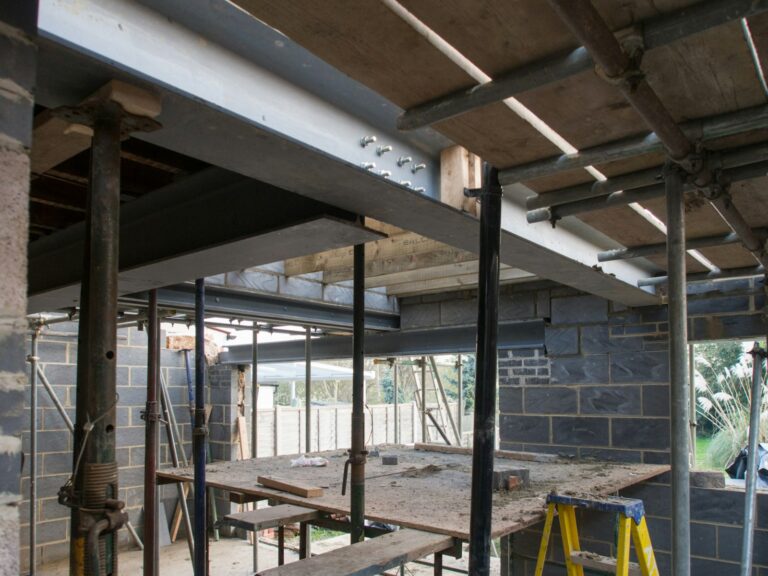
- A steel beam: a steel beam (RSJ) on padstones, often spanning into the party wall or across to the side walls. It costs more than brackets but works in more situations, and building control is more comfortable with it. Our steel beam cost guide has supply and fit prices.
Either way, your builder needs calculations from a structural engineer to show building control.
Whether the chimney is shared
In terraced and semi-detached houses, the chimney usually sits on the party wall. Often your breast and your neighbour’s are built back-to-back, with flues side by side. That brings in the Party Wall Act, and it can limit what support method is allowed (more on this below).
Making good
Once the breast is gone you’ll have a rough wall, a hole in the floor where the hearth was, and sometimes damaged ceiling and skirting. MyJobQuote says making good can add around £1,000. If you remove the stack too, the roof needs felting, battening and tiling over.
Access and waste
A chimney breast is a lot of brick. A single breast can fill a small skip. Terraced houses with no side access mean every bag goes through the house, which adds time. Stack removal needs scaffolding, and on a busy street you may also need a council licence for scaffolding or a skip on the road.
Building regulations for chimney breast removal
Removing a chimney breast is structural work, so it needs building regulations approval in almost every case. Redbridge Council’s guidance says the work must make sure “the remaining part of the stack is properly supported”, and a building control application is required. If you’re removing the whole chimney from ground to roof, you’re still altering the structure and should apply.
Council fees in 2026
Fees are set locally. Here’s what three councils charge in 2026/27:
| Council | Full plans or building notice | Regularisation (after the event) | Notes |
|---|---|---|---|
| Burnley | £338 (incl VAT) | From about £423 (150% of the net fee, no VAT) | Fixed fee for “removal or partial removal of chimney breast(s)” |
| Redbridge | £370 (work up to £2,000) or £528 (£2,000–£5,000), incl VAT | About £462.50 or £660 | Charged by estimated cost of the work, not a set chimney fee |
| Enfield | £457 (incl VAT) | £571.25 (no VAT) | Fixed fee for removal of chimney breasts |
Sources: Burnley, Redbridge and Enfield fee schedules from April 2026. Private building control approvers set their own prices; Checkatrade quotes around £200 plus VAT. MyJobQuote gives £200–£400 as a general range.
For a simple job, a building notice lets work start soon after you give notice. MyJobQuote says two days. A full plans application can take up to five weeks. For the wider picture, see our building regulations cost guide.
The gallows bracket rules
Gallows brackets have been used for decades, but councils have become much stricter. Redbridge’s guidance now says it will no longer accept them unless its rules are followed and checked on site. Brackets need a structural design and pull-out testing before the work is signed off. Redbridge only allows them where all of these apply:
- the stack isn’t completely vertical;
- the neighbour’s chimney breast on the party wall hasn’t been removed;
- the supporting party wall is at least 215mm thick, in sound brickwork;
- the breast is no wider than 1,200mm (with two flues) and projects no more than 340mm;
- the house has no more than two storeys;
- Party Wall Act notices have been served where needed.
Redbridge also says the brackets must be 75×75×6mm steel angles fixed into sound brickwork, not mortar joints. A steel plate on top catches soot, and the stack needs a ventilated cowl and an air brick lower down. If brackets aren’t suitable, you’ll need a steel beam designed by an engineer. Steel or brackets below roof level need at least 30 minutes’ fire protection. Other councils have similar rules, so check yours before you budget for brackets.
Other checks building control makes
- Buttressing: a chimney can brace a long wall. If it does, Redbridge says an engineer must design the alterations before work starts.
- Cross-over flues: Redbridge says a breast with flues crossing over can’t be removed.
- Your neighbour’s flues: if the brickwork between your flue and theirs is damaged, smoke or carbon monoxide can leak. Damaged brickwork must be repaired and a smoke test carried out.
- Hearths: any concrete hearth on the first floor should come out, with new timber joists fitted to fill the gap.
Party walls and planning
Party wall notices
The Party Wall etc. Act 1996 gives you the right, in section 2(2)(g), to cut away “any projecting chimney breast, jamb or flue” from a party wall. But you must serve notice first. Under section 3(2)(a), a party structure notice must be served at least two months before the work starts. If your neighbour agrees in writing, you can go ahead. If they don’t respond or they dissent, you’ll need a party wall surveyor. Our guides to the party wall agreement and party wall surveyor cost explain both routes. Homebuilding & Renovating’s 2022 guide put a party wall award at upwards of £700 plus VAT per neighbour.
Do you need planning permission?
Removing a chimney breast inside the house doesn’t normally need planning permission. Removing the stack above the roof is usually fine too, but not always. In a conservation area, or where the stack is part of a terrace’s look, your council may want an application. Listed buildings need listed building consent for almost any change to a chimney. If you do need a householder planning application in England, the fee is currently £548. Fees rise from 8 December 2026 under SI 2026/1192 (made 10 November 2026), with the householder fee going to £575.
Worked examples
These budgets use the price guide figures above and 2026 council fees. They’re illustrations, not quotes. Our pricing method explains how we put figures like these together.
Worked example 1: ground floor breast in a terrace, Redbridge
A two-up two-down terrace. The owners want the living room breast out to fit a wider sofa. The breast above and the stack stay, held up by a steel beam or brackets designed by an engineer.
| Item | Low | High |
|---|---|---|
| Remove ground floor breast | £1,500 | £1,750 |
| Structural engineer | £250 | £600 |
| Building control fee (Redbridge band) | £370 | £528 |
| Making good | £750 | £1,250 |
| Skip | £100 | £200 |
| Total | £2,970 | £4,328 |
If the breast is on the party wall, add the cost of party wall notices, and a surveyor if your neighbour doesn’t agree. The low fee band applies only if the estimated cost of the work is under £2,000.
Worked example 2: whole chimney, ground floor to roof, Enfield
A semi-detached house. The owners are removing both breasts and the stack, then tiling over the roof. There’s nothing left to support, but the work is on the party wall.
| Item | Low | High |
|---|---|---|
| Remove full breast and stack | £3,000 | £3,500 |
| Scaffolding | £300 | £660 |
| Structural engineer (check of the party wall) | £250 | £600 |
| Building control fee (Enfield) | £457 | £457 |
| Making good (both floors) | £750 | £1,250 |
| Skip | £100 | £200 |
| Party wall award, if needed (£700 + VAT) | £0 | £840 |
| Total | £4,857 | £7,507 |
The low figure assumes your neighbour agrees to the party wall notice. Redecorating two rooms, new flooring and any roof repairs beyond a simple tile-over come on top.
Worked example 3: breast in the loft, for a loft conversion, Burnley
Loft conversions often need the breast in the loft taken out to free up floor space. The stack above the roof stays, so it needs new support.
| Item | Low | High |
|---|---|---|
| Labour to remove loft breast (team of two) | £400 | £1,200 |
| Steel or brackets, supplied and fixed (our estimate) | £400 | £500 |
| Structural engineer | £250 | £600 |
| Building control fee | £338 | £528 |
| Skip | £100 | £200 |
| Total | about £1,500 | about £3,000 |
Exact sums: £1,488 and £3,028. The high fee assumes a council charging by the value of the work, as Redbridge does. Labour is MyJobQuote’s labour-only figure for stack and loft breast work.
If you’re converting the loft anyway, the chimney work is often priced into the conversion and covered by the same building control application. See our loft conversion cost guide. If you’re also opening up a ground floor wall, our load-bearing wall removal cost guide shows how the two jobs can share an engineer and a steel delivery.
Thinking of removing a chimney breast? Tell us about your house and we’ll pass your details to one vetted local builder who can price the work, the support and the making good.
Step by step: how removal works
- Check the chimney. Find out if it’s shared, if the neighbour’s breast has gone, and whether any flue is still in use. Have any gas fire disconnected by a Gas Safe engineer.
- Get calculations. An engineer designs the support for anything left above.
- Serve notices. Party wall notice at least two months ahead if the chimney is on a party wall. Building control application before work starts.
- Protect the house. Dust sheets, sealed doors and a clear route to the skip. Chimney removal is extremely dusty.
- Remove and support. The builder fits temporary props, takes out the brickwork and fits the permanent steel or brackets. Building control inspects the support before it’s covered up.
- Make good and sign off. Plaster, fill the floor, cap or ventilate the flue, and get the completion certificate. Keep it: a buyer’s solicitor will ask for it.
What if a chimney breast was removed without approval?
It’s common to buy a house where a previous owner took out the ground floor breast with no paperwork. The breast above may be held up by little more than a couple of brackets, or nothing at all. If you suspect this, get a structural engineer to look. The fix is usually a regularisation application to the council, which costs more than applying at the start (£571.25 in Enfield, and from about £423 in Burnley), plus whatever support work is needed. Indemnity insurance may satisfy a lender, but it won’t make the chimney safe.
Chimney breast removal cost FAQs
How much does it cost to remove a chimney breast in the UK?
Around £1,500–£2,000 for one breast on one floor, according to MyJobQuote’s November 2026 guide. Checkatrade quotes £1,750–£3,250 plus VAT. Removing the whole chimney including the stack costs about £3,000–£3,500 for the work, and roughly £5,000–£7,500 once scaffolding, making good and fees are added.
How much does chimney stack removal cost?
MyJobQuote puts removing a stack alone at £1,200–£1,400. Checkatrade gives about £300 per metre, or around £1,800 for a typical project. Scaffolding and roof repairs can add several hundred pounds.
Do you need building regulations to remove a chimney breast?
Yes, in almost all cases. It’s structural work, and building control needs to see that anything left above is properly supported. Council fees in 2026 are about £338 (Burnley) to £457 (Enfield), including VAT.
Are gallows brackets still allowed?
Sometimes, but many councils now restrict them. Redbridge, for example, only accepts them with a structural design and pull-out tests, on a sound party wall at least 215mm thick, in a house of no more than two storeys, where the neighbour’s breast is still in place. Otherwise a steel beam is needed.
Do I need a party wall agreement to remove a chimney breast?
If the chimney is on a party wall, yes. You must serve a party structure notice at least two months before work starts. If your neighbour agrees in writing, you can go ahead; if not, a party wall surveyor will prepare an award.
How long does it take to remove a chimney breast?
A ground floor breast usually takes 1.5–2 days. A full breast and stack takes 3–4 days, according to MyJobQuote. Making good adds another 1–2 days, and a full plans building control application can take up to five weeks before you start.
Does removing a chimney breast devalue a house?
Not usually, if the work is done properly and signed off. Extra floor space can help a small room. Problems come when there’s no completion certificate, or when the support above is inadequate, which can put buyers and lenders off.
Can I remove a chimney breast myself?
You can, but you still need building control approval, structural calculations and party wall notices. Taking out the wrong brickwork can bring the breast above down, so most people use an experienced builder.
Sources
- MyJobQuote: Chimney breast removal cost (updated 3 Nov 2026)
- Checkatrade: Chimney removal cost guide (updated April 2026)
- Homebuilding & Renovating: What does chimney breast removal cost? (October 2022)
- Hamuch: Remove chimney breast cost (updated 4 March 2026)
- Redbridge Council: Chimney breasts removal guidance
- Fees: Burnley scale of charges April 2026–27; Redbridge fee schedule from 1 April 2026; Enfield building control charges April 2026 to 2027
- Legislation: Party Wall etc. Act 1996, section 2 and section 3
This guide is general information for England, checked on 16 November 2026. It isn’t legal, structural or professional advice. Prices and fees change, and your building control body and structural engineer have the final say on what your chimney needs. Wales, Scotland and Northern Ireland have their own rules.